Table of Contents
Key Takeaways
- Gua sha uses controlled scraping motions with a flat-edged tool to stimulate lymphatic drainage and release facial muscle tension
- Jade rolling provides gentle surface massage and temporary de-puffing through cooling and circulation stimulation
- Rose quartz stays cooler longer than jade, making it more effective for de-puffing when stored in the refrigerator
- A five-minute daily routine combining both tools can improve product absorption and give skin a more sculpted appearance
- Evidence supports temporary lymphatic benefits, but bone structure changes and permanent face sculpting are not realistic outcomes
Facial massage tools have become a staple in modern skincare routines, but their origins trace back thousands of years. Gua sha emerged from Traditional Chinese Medicine as a therapeutic technique for moving stagnant energy and promoting circulation throughout the body. Jade rollers have been used in East Asian beauty rituals for centuries, prized for their cooling and calming effects on the skin.
The social media resurgence of these tools has brought them to a global audience, but the claims surrounding them range from the scientifically grounded to the wildly exaggerated. Understanding what these tools can and cannot do requires separating traditional wisdom from modern marketing, and clinical evidence from anecdotal enthusiasm.
Traditional Chinese Medicine Origins
Gua sha, which translates to scraping sha or sand, is a technique documented in Chinese medical texts dating back to the Ming Dynasty (1368-1644). In TCM practice, a practitioner scrapes the skin with a smooth-edged tool until petechiae, those characteristic red marks, appear, indicating the release of blood stagnation and the movement of qi, or vital energy. The technique was traditionally applied to the back, shoulders, and limbs to treat pain, fever, and respiratory conditions.
Facial gua sha is a much gentler adaptation of this practice, using lighter pressure and a different tool shape designed for the contours of the face. The goal is not to create petechiae but to stimulate lymphatic drainage, relax muscle tension, and improve microcirculation. Jade rolling emerged from a similar tradition, with jade stones valued in Chinese culture for their cooling properties and symbolic association with purity and harmony.
The modern aesthetic adaptation of these techniques retains the core principles, manual stimulation of tissue to improve fluid dynamics and circulation. What has changed is the intensity, frequency, and integration with contemporary skincare products. A jade roller or gua sha tool used correctly is a complement to a routine, not a replacement for evidence-based skincare actives.
Proper Technique: Angle, Pressure, and Direction
Technique determines whether gua sha and jade rolling deliver benefits or cause irritation. Using these tools incorrectly, with too much pressure, the wrong angle, or against lymphatic flow, can cause broken capillaries, bruising, and skin laxity over time. Mastering the fundamentals is essential before adding these tools to your daily routine.
For gua sha, hold the tool at a 15 to 30 degree angle to the skin, never perpendicular. The flat edge should be in full contact with the skin surface. Apply light to medium pressure, enough to feel the tissue move beneath the tool but not enough to cause pain or visible indentation. Always move upward and outward, following the natural lines of the face from center to periphery, chin to ear, nose to temple, brow to hairline. Each stroke should be slow and deliberate, taking 3 to 5 seconds per pass. Repeat each stroke 3 to 5 times before moving to the next section.
For jade rolling, the technique is simpler but still requires attention to direction. Always roll upward and outward, never drag the skin downward. Use the larger end of the roller for the cheeks, forehead, and jawline. Use the smaller end for under the eyes, around the nose, and along the brow bone. Roll each area 5 to 10 times, applying consistent light pressure. The roller should glide smoothly, not catch or pull the skin. If you feel resistance, you need more slip from your product.
"The most common mistake people make with gua sha is using too much pressure and moving too quickly. Think of it as a slow, meditative practice, not a vigorous massage. Each stroke should be deliberate enough that you can feel the tissue release under the tool. Rushing through the routine not only reduces effectiveness but increases the risk of capillary damage."
Jade vs Rose Quartz vs Stainless Steel
The material of your tool matters more than most people realize. Different stones and materials have different thermal properties, hardness levels, and maintenance requirements that affect both the user experience and the tool's effectiveness.
Jade is the traditional material, prized for its cultural significance and smooth texture. Nephrite jade is more durable and less porous than the cheaper serpentine often sold as jade in mass-market tools. Genuine jade stays cool to the touch but warms to skin temperature relatively quickly. It is moderately hard, making it suitable for both rolling and gua sha, though softer grades can develop surface scratches over time.
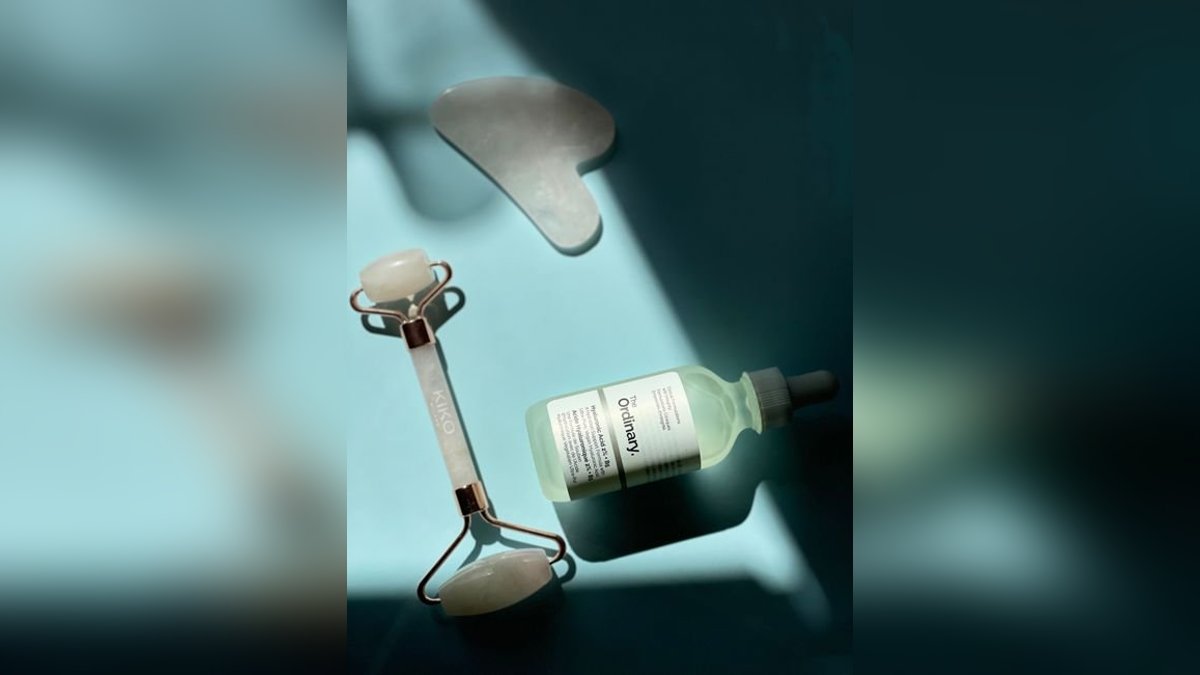
Rose quartz has become the most popular modern material for facial tools. It is harder than jade on the Mohs scale, meaning it resists scratching and maintains its polished surface longer. Rose quartz also has superior thermal retention properties, staying cool for longer when refrigerated, which makes it more effective for de-puffing applications. The crystal structure is non-porous and easy to clean, reducing bacterial accumulation between uses.
Stainless steel offers the best thermal properties of all options. It can be refrigerated to provide intense cold therapy that constricts blood vessels and reduces puffiness rapidly. Stainless steel tools are non-porous, hygienic, and virtually indestructible. They do not carry the same aesthetic appeal or traditional significance as stone tools, but from a purely functional perspective, they outperform both jade and rose quartz for lymphatic drainage and cooling applications.
| Property | Jade | Rose Quartz | Stainless Steel |
|---|---|---|---|
| Hardness | Moderate (6-6.5 Mohs) | Hard (7 Mohs) | Very Hard |
| Cool Retention | Short | Medium | Long |
| Porosity | Low to medium | Non-porous | Non-porous |
| Best For | Traditional practice | Daily facial massage | Cold therapy, de-puffing |
| Durability | Can scratch | Resists scratching | Virtually indestructible |
The Five-Minute Daily Routine
An effective facial massage routine does not require elaborate preparation or 20-minute time commitments. The following five-minute protocol combines gua sha and jade rolling techniques for maximum benefit in minimal time. Perform this routine on clean, damp skin after applying your serum or moisturizer to provide slip for the tools.
Minute 1 (Neck and Jaw): Start with the neck, using the gua sha tool flat against the skin. Stroke from the collarbone up to the jawline, 5 times on each side. This opens the lymphatic drainage pathways before working on the face. Then use the roller's larger end along the jawline from chin to ear, 5 passes per side.
Minute 2 (Cheeks): Using the gua sha tool, place the curved notch under the cheekbone and sweep from the nose outward toward the temple and ear. Repeat 5 times per section, covering the lower cheek, mid-cheek, and upper cheek. Follow with the roller in upward strokes from the nasolabial fold area toward the ear.
Minute 3 (Forehead and Brows): Switch to the smaller end of the gua sha tool. Work from the center of the forehead outward toward the temples in 5 sweeping strokes. Follow the brow bone from the inner corner outward. Use the small end of the roller under the brow bone and across the forehead horizontally.
Minute 4 (Eye Area): Use the small end of the roller under the eyes, starting at the inner corner and rolling outward toward the temple. Do not roll back and forth; always roll in one direction. Use the gua sha tool's smallest edge in gentle outward strokes under the eye area, using very light pressure, about a quarter of the pressure used on the cheeks.
Minute 5 (Finish and Drain): Finish by tapping the fingertips lightly across the entire face to stimulate microcirculation. Then perform three final gua sha passes on each side of the face from the center outward, ending at the lymph nodes behind the ears and down the neck. Clean both tools with mild soap and water and pat dry.
Evidence vs Anecdote
The claims made for gua sha and jade rolling span a wide spectrum. Some benefits are supported by basic physiology, while others are marketing narratives with little scientific backing. Understanding which claims are evidence-based helps you set realistic expectations and use these tools effectively.
Supported by evidence: Temporary reduction in facial puffiness through mechanical lymphatic drainage is well-documented. Increased surface circulation during and immediately after massage is measurable. Improved absorption of topically applied products through enhanced microcirculation is physiologically plausible. Muscle relaxation in the masseter and temporalis muscles from consistent gua sha technique is supported by physical therapy literature on myofascial release.
Not supported by evidence: Permanent face shape changes, lifted cheekbones, reduced nose width, corrected facial asymmetry, elimination of deep wrinkles, and tightened sagging skin are all unrealistic expectations. The visible effects of facial massage are primarily fluid-based and temporary, lasting hours to days depending on your lymphatic system's efficiency and fluid intake. Long-term collagen stimulation from mechanical massage is theoretically possible but not clinically demonstrated in peer-reviewed research.
Approach these tools as part of a holistic self-care practice with real but limited aesthetic benefits. The ritual itself has value, providing a few minutes of focused self-massage that reduces stress and increases awareness of facial tension patterns. Combined with a solid skincare foundation including sunscreen, retinol, and antioxidants, gua sha and jade rolling can enhance your routine without replacing any evidence-based steps.
"Social media has created impossible expectations for facial tools. No amount of jade rolling will change your bone structure or replace a facelift. But the real benefits, reduced puffiness, relaxed jaw muscles, better product absorption, improved circulation, and a few minutes of mindful self-care, are genuinely worthwhile. The key is to use the tools correctly and measure success by realistic standards."
Frequently Asked Questions
Common concerns about gua sha, jade rolling, and facial massage tools
What is the difference between gua sha and jade rolling?
Gua sha involves scraping the skin with a flat-edged tool using specific angles and pressure to stimulate lymphatic drainage and release muscle tension. Jade rolling uses a roller ball to glide over the skin for a gentler, more superficial massage. Gua sha provides deeper, more targeted results for sculpting and tension relief, while jade rolling is better for quick de-puffing and product absorption. Many people use both tools in sequence for comprehensive facial massage.
How often should I use gua sha on my face?
For most skin types, gua sha can be used 3 to 5 times per week. Sensitive skin or those with rosacea should start with 1 to 2 times per week and monitor for irritation. Each session should last 3 to 5 minutes per side of the face. Overuse can cause bruising or capillary damage, so listen to your skin and reduce frequency if you notice persistent redness or broken capillaries.
Does jade or rose quartz roller actually do anything for your skin?
Facial rollers provide several measurable benefits when used correctly. The physical massage stimulates circulation, which brings oxygen and nutrients to skin cells. The cooling effect of storing the roller in the refrigerator constricts blood vessels and temporarily reduces puffiness. Rolling also helps products absorb more deeply by creating micro-circulation. However, most benefits are temporary lasting hours to a day. Rose quartz is slightly harder and stays cooler longer than jade.
Can gua sha really change your face shape?
Gua sha cannot change bone structure or redistribute fat, but it can create the appearance of a more sculpted face by reducing fluid retention and relaxing tense muscles. Lymphatic drainage reduces facial puffiness, making the jawline appear sharper and cheekbones more defined. Muscle tension release in the jaw and temples softens a clenched appearance. These effects are temporary and last 24 to 48 hours.
What oil or serum is best to use with gua sha tools?
A slip-rich, non-absorbent oil or serum is essential for gua sha to prevent dragging the tool across the skin. Face oils with high slip like squalane, jojoba, or grapeseed oil work well. Avoid products that dry down quickly or contain active exfoliants (AHAs, BHAs, retinoids) that could cause irritation when massaged deeper into the skin. Apply a generous amount so the tool glides smoothly without resistance.
Related Articles
Your Next Step
Start with a single tool rather than buying a full set. A rose quartz gua sha tool offers the best balance of thermal performance, durability, and versatility for beginners. Pair it with a high-slip oil like squalane or jojoba, and commit to the five-minute daily routine for at least two weeks before evaluating results.
Pay attention to how your face feels after each session, not just how it looks. Reduced tension in the jaw, a sense of relaxation, and improved product absorption are all valid and valuable outcomes that go beyond what any tool claims to do for your appearance. For more on building your complete routine, explore our All Articles.