Table of Contents
Key Takeaways
- The Andre Walker system classifies hair into four types: straight (1), wavy (2), curly (3), and coily (4), with three subcategories each
- Hair porosity measures how well your hair absorbs and retains moisture — low, medium, or high — and determines which products work best
- The at-home float test reveals your porosity level in minutes using nothing but a glass of water and a clean strand of hair
- Each hair type and porosity combination requires a different approach to cleansing, conditioning, and styling
- Porosity can change over time due to heat styling, chemical treatments, and environmental damage, so retest periodically
Walking into a beauty supply store with hundreds of products promising perfect hair can feel overwhelming. The shampoos, conditioners, leave-ins, oils, and creams all claim to deliver results, but most of them are formulated for specific hair types. Using the wrong products is the most common reason hair routines fail.
Understanding your hair type and porosity removes the guesswork. When you know whether your strands are straight, wavy, curly, or coily and how well they absorb moisture, selecting the right products becomes a science rather than a gamble. This guide breaks down the standard hair typing system, explains how to test your porosity at home, and gives practical product recommendations for every combination.
The Andre Walker Hair Typing System
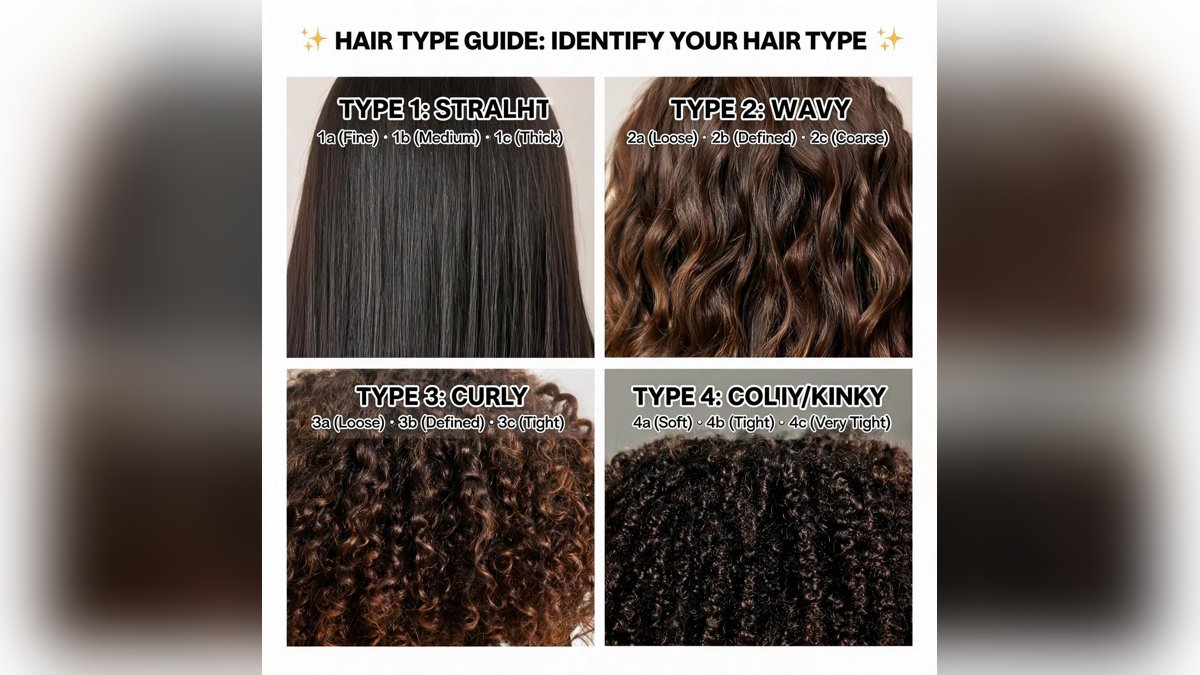
The most widely accepted hair classification system was developed by celebrity hairstylist Andre Walker and adopted by the haircare industry as a standard reference. It divides hair into four main types determined by the shape of the hair follicle and the resulting curl pattern. The number of each type increases with the degree of curl or coil.
Your hair type is determined by genetics, specifically the shape of your hair follicle. Oval and asymmetrical follicles produce curly hair, while round follicles produce straight hair. The angle of the follicle relative to your scalp also plays a role — the more angled the follicle, the curlier the resulting strand.
Type 1: Straight Hair
Straight hair has no natural curl or wave. The follicle is round, and the hair shaft lies flat against the scalp, allowing sebum (natural oil) to travel from root to tip easily. Type 1A is fine and very straight with a silky texture. Type 1B has medium thickness and more volume. Type 1C is coarse and may have a slight bend but no defined wave. Straight hair tends to look shiny because the smooth cuticle reflects light well, but it can become greasy quickly since oils travel freely down the shaft.
Type 2: Wavy Hair
Wavy hair forms an S-shape when dry and falls between straight and curly. The follicle is slightly oval. Type 2A features loose, fine waves that are easy to straighten. Type 2B has more defined S-waves that start mid-length and tend to frizz in humidity. Type 2C waves are thicker and coarser, with some strands forming loose spirals. Wavy hair often struggles with frizz because the cuticle is naturally raised in the wave bends, making it more porous at those points.
Type 3: Curly Hair
Curly hair forms defined ringlets or corkscrews and has a distinct oval to asymmetrical follicle shape. Type 3A curls are loose, large spirals about the width of sidewalk chalk. Type 3B curls are medium-sized ringlets ranging from springy to tight. Type 3C curls are tight corkscrews with dense volume and a visible curl pattern. Curly hair tends to be dry because natural oils struggle to travel down the zigzag path of the strand, so regular deep conditioning is essential.
"The curl pattern is the least important factor in choosing products — porosity and density matter far more. Two people with 3B curls can have completely different porosity levels and need entirely different products. Knowing your porosity transforms your haircare routine from guessing to prescribing."
Type 4: Coily Hair
Coily or kinky hair features tight coils or zigzag patterns with the highest density of strands per square inch. The follicle is distinctly asymmetrical. Type 4A coils are soft and have a visible S-pattern when stretched. Type 4B strands bend in sharp Z-shaped angles with less defined curl structure. Type 4C is the most tightly coiled, with strands that pack tightly together and show minimal defined curl pattern even when stretched. Type 4 hair is the most fragile and prone to breakage because each bend in the strand creates a potential weak point. Consistent moisturizing and protective styling are non-negotiable for maintaining length.
Understanding Hair Porosity
Hair porosity refers to your hair's ability to absorb and retain moisture. It is determined by the condition of the cuticle layer — the outermost protective shell of each strand. When the cuticle lies flat and tight, moisture has difficulty entering but also has difficulty escaping. When the cuticle is raised or damaged, moisture enters quickly but leaves just as fast. Porosity is categorized into three levels.
Low porosity hair has tightly packed cuticles that lie flat and overlap snugly. Water, oils, and conditioners sit on top of the strand rather than absorbing. Low porosity hair takes a long time to wet in the shower and even longer to dry. Products tend to build up on the surface, leading to weighed-down, greasy-looking hair. This type benefits from lightweight, water-based products and heat during conditioning to open the cuticles.
Medium porosity hair has a slightly raised cuticle layer that allows the right amount of moisture in while retaining it effectively. This is the ideal porosity level. Medium porosity hair holds styles well, responds to treatments predictably, and rarely feels either greasy or overly dry. Products absorb at a moderate rate, and the hair has a natural, healthy shine.
High porosity hair has raised or damaged cuticles with gaps and holes in the protective layer. Moisture enters the strand quickly but escapes just as fast, leaving hair dry, frizzy, and prone to tangling. High porosity hair absorbs products immediately but feels dry again within hours. This type results from genetics, heat damage, chemical processing, or environmental stress. It needs protein treatments to fill the gaps and heavier butters and oils to seal moisture in.
The At-Home Porosity Float Test
Testing your porosity at home takes less than five minutes. Start with clean, product-free hair. Take a single strand and drop it into a glass of room-temperature water. Do not disturb the glass. Observe the strand for 2 to 4 minutes.
If the strand floats on top of the water, you have low porosity hair. The cuticles are so tightly closed that water cannot penetrate the strand, keeping it buoyant. If the strand sinks to the middle third of the glass, you have medium porosity. The cuticle allows a balanced amount of moisture in. If the strand sinks quickly to the bottom, you have high porosity. The raised cuticles let water rush into the strand, making it heavy enough to sink.
The strand test can also be performed by sliding your fingers up a single strand from tip to root. If it feels smooth, your cuticles are flat (low porosity). If it feels bumpy or catches, your cuticles are raised (high porosity). For more insights on building a routine around your specific needs, see our guide to starting retinol without irritation.
Hair Care by Type and Porosity
Once you know both your hair type and porosity, you can build a targeted routine. The following table summarizes the best approach for each major combination.
| Hair Type | Low Porosity | Medium Porosity | High Porosity |
|---|---|---|---|
| Straight (Type 1) | Lightweight shampoo, no heavy conditioners, clarify weekly | Regular shampoo and conditioner, occasional deep treatment | Gentle sulfate-free shampoo, protein treatments monthly |
| Wavy (Type 2) | Water-based leave-in, avoid butters, use heat when conditioning | Light hold products, gel or mousse for curl definition | Cream-based leave-in, protein masks, seal with light oil |
| Curly (Type 3) | Clarify monthly, use warm water, lightweight creams | Deep condition weekly, curl cream + gel for styling | Protein treatments every 2 weeks, heavy butter to seal |
| Coily (Type 4) | Steam conditioning, liquid leave-in first, then cream | Consistent deep conditioning, protective styling recommended | Frequent protein + moisture balance, regular trims to prevent breakage |
Washing and Conditioning Tips
How often you wash your hair depends more on your scalp type than your hair type. Oily scalps need more frequent washing, typically every 1 to 3 days. Dry scalps can go longer — 5 to 7 days between washes. Regardless of frequency, always condition after every wash. Focus conditioner on the mid-lengths and ends, not the scalp. For Type 3 and Type 4 hair, consider co-washing (washing with conditioner only) between full shampoo sessions to retain moisture. Low porosity hair benefits from pre-pooing with a lightweight oil before shampooing to prevent stripping.
Styling and Heat Protection
Heat styling damages the cuticle layer and raises porosity over time. Always use a heat protectant spray before blow-drying, curling, or flat-ironing. Keep heat tools below 350 degrees Fahrenheit for fine hair and below 400 degrees for coarse hair. Air drying is the healthiest option for most hair types, but if you must use heat, limit it to once per week. For Type 4 hair, minimize direct heat and rely on heatless styling methods like twist-outs, braid-outs, and flexi rods. To learn more about building a comprehensive beauty routine, read the complete guide to building an acne-safe skincare routine.
Seasonal Adjustments
Hair needs change with the seasons. Summer humidity increases frizz for Types 2 through 4, while winter dryness exacerbates dehydration. In humid months, use anti-humectant products that seal the cuticle and prevent moisture from swelling the strand. In dry winter months, increase deep conditioning frequency and use heavier leave-in products. Sun exposure also damages hair — UV protection sprays or hats are recommended for extended outdoor time, especially for chemically treated or high porosity hair. Understanding ingredient labels helps you choose the right products for each season — check how to read skincare ingredient labels like a pro for tips that apply equally to haircare.
"Seasonal hair changes are normal and expected. If your summer routine stops working in winter, do not force it — your hair is telling you it needs different ingredients. The single most important haircare skill is learning to observe and respond rather than sticking to a rigid routine year-round."
Frequently Asked Questions
Common concerns about identifying your hair type, porosity, and choosing the right products
What is the difference between hair type and hair porosity?
Hair type refers to the natural shape and texture of your hair strands, ranging from straight (Type 1) to tightly coiled (Type 4). Hair porosity describes how well your hair absorbs and retains moisture, determined by the condition of the cuticle layer. You can have any hair type with any porosity level, and understanding both is essential for choosing the right products and techniques.
How do I perform the hair porosity float test at home?
Take a clean, dry strand of hair and drop it into a glass of room-temperature water. Let it sit for 2 to 4 minutes. If the strand floats on top, you have low porosity hair (cuticles are tight, resistant to moisture). If it sinks slowly to the middle, you have medium porosity. If it sinks quickly to the bottom, you have high porosity hair (cuticles are raised or damaged, moisture escapes easily).
Can your hair type change over time?
Hair type can change due to hormonal shifts (pregnancy, menopause, thyroid conditions), aging, chemical treatments (relaxers, perms, bleaches), and medication. Curly hair can become straight or vice versa. Porosity is more likely to change than curl pattern, especially after heat damage, coloring, or chemical processing. It is normal for your hair to show different textures in different sections.
What products work best for low porosity hair?
Low porosity hair benefits from lightweight, water-based products that do not sit on top of the strand. Look for humectants like glycerin, honey, and aloe vera. Avoid heavy butters (shea butter, cocoa butter) and oils (coconut oil) that can create buildup. Use warm water to open the cuticles before conditioning, and clarify regularly to remove product residue.
How do I determine my curl pattern using the Andre Walker system?
The Andre Walker system classifies hair into four types. Type 1 is straight with no curl. Type 2 is wavy, forming an S-shape (2A loose waves, 2B defined S-waves, 2C coarse waves). Type 3 is curly, forming spiral ringlets (3A loose curls, 3B medium curls, 3C tight corkscrews). Type 4 is coily or kinky, with tight zigzag patterns (4A soft coils, 4B Z-shaped curls, 4C tightly packed coils with minimal defined curl pattern).
Related Articles
Your Next Step
Start by identifying your curl pattern using the Andre Walker descriptions above — wash your hair and let it air dry without products to see your natural texture. Then perform the porosity float test with a single clean strand. With both pieces of information, you can choose products that match your specific needs rather than guessing based on packaging claims.
Remember that porosity is the more actionable metric for product selection. Two people with the same curl pattern may need completely different routines if one has low porosity and the other has high porosity. Build your routine from the porosity outward, then adjust for curl pattern. Retest your porosity every six months or after any significant chemical treatment, as it can change over time. For more haircare guidance, explore our All Articles.