Table of Contents
Key Takeaways
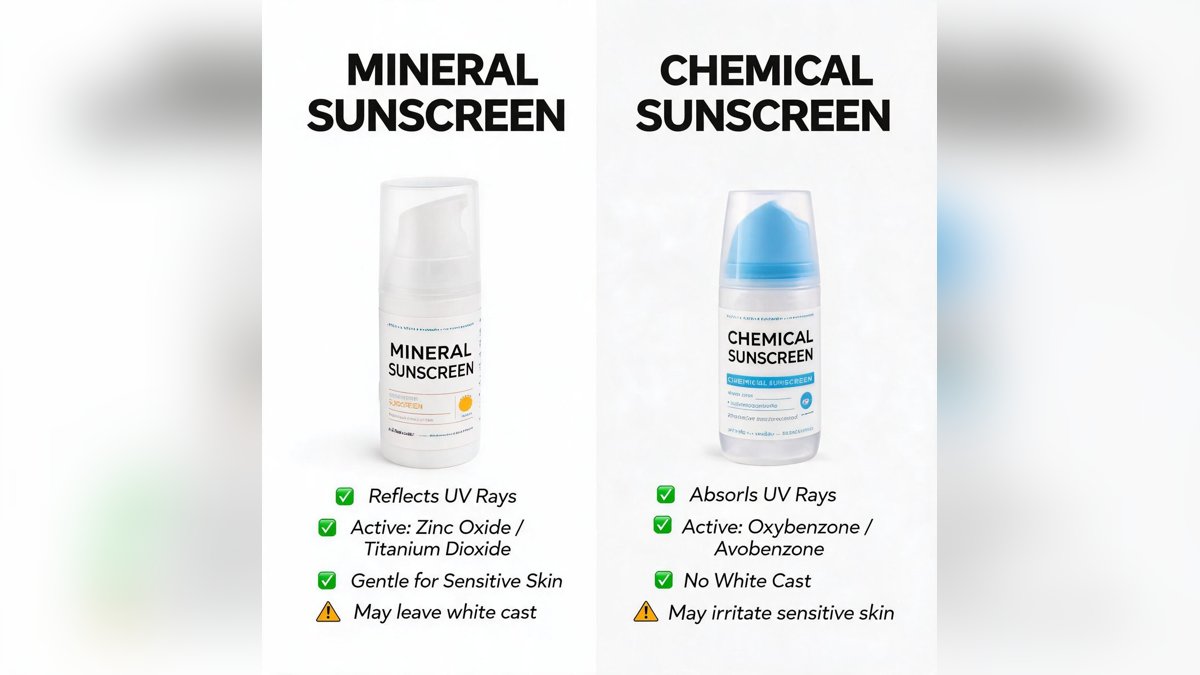
- Mineral sunscreens sit on the skin and reflect UV, while chemical sunscreens absorb UV and convert it to heat
- Mineral sunscreens work immediately but can leave a white cast; chemical sunscreens need 15 minutes but are invisible
- Sensitive and reactive skin types generally tolerate mineral sunscreens better
- Chemical filters oxybenzone and octinoxate are banned in some regions due to coral reef concerns
- Modern micronized mineral sunscreens significantly reduce the white cast issue
The mineral versus chemical sunscreen debate is one of the most discussed topics in skincare. Both types protect your skin from UV damage, but they work through completely different mechanisms and have distinct advantages and disadvantages depending on your skin type, lifestyle, and environmental concerns.
This guide provides a side-by-side comparison of mineral and chemical sunscreens, explains how each type works, and helps you choose the right formulation for your specific needs.
How Mineral and Chemical Sunscreens Work
Mineral sunscreens, also called physical sunscreens, use inorganic compounds that sit on top of the skin and physically block or scatter UV radiation. The two FDA-approved mineral filters are zinc oxide and titanium dioxide. Zinc oxide provides broad-spectrum protection against UVA and UVB. Titanium dioxide primarily protects against UVB and short UVA rays. Mineral sunscreens start working immediately upon application because they do not need to be absorbed into the skin.
Chemical sunscreens use organic carbon-based compounds that absorb UV radiation and convert it into heat, which is then released from the skin. Common chemical filters include avobenzone (UVA protection), octinoxate (UVB), octisalate (UVB), homosalate (UVB), octocrylene (UVB), and oxybenzone (UVA and UVB). Chemical sunscreens require about 15 to 20 minutes after application before they become effective because they need to be absorbed into the outer layers of the skin.
Pros and Cons Comparison
| Factor | Mineral (Physical) | Chemical |
|---|---|---|
| Immediate protection | Yes, works right away | Needs 15-20 min to activate |
| White cast | Can leave visible white residue | No white cast, transparent |
| Texture | Thicker, can feel heavy | Lightweight, spreads easily |
| Skin irritation | Rare, suitable for sensitive skin | Some filters can cause stinging |
| Eye stinging | Minimal to none | Can sting eyes, especially avobenzone |
| Acne safety | Generally non-comedogenic | Depends on formulation |
| Reef safety | Considered reef-safe | Some filters banned in certain regions |
| UVA protection | Zinc oxide provides excellent UVA protection | Depends on filter combination |
Best Choice by Skin Type
Sensitive skin generally tolerates mineral sunscreens better because zinc oxide and titanium dioxide are inert and do not penetrate the skin. Chemical filters, especially oxybenzone and octinoxate, can cause stinging, burning, or allergic reactions in sensitive individuals. If you have rosacea, eczema, or reactive skin, choose a mineral sunscreen with at least 15 percent zinc oxide.
Acne-prone skin can use either type, but the formulation matters more than the filter type. Mineral sunscreens are less likely to clog pores because they sit on the skin surface. However, some mineral formulations use heavy creams or oils that can be comedogenic. Chemical sunscreens with lightweight, gel-based formulations often work well for oily and acne-prone skin, but avoid those with high concentrations of oils or silicones.
Dark skin can be challenging with mineral sunscreens because of the white cast. Modern micronized and tinted mineral sunscreens have improved significantly. Look for "invisible" or "sheer" mineral formulations with nanoparticle-sized zinc oxide, or tinted versions that blend into deeper skin tones. Chemical sunscreens are generally preferred for dark skin because they leave no visible residue.
"The best sunscreen is the one you will wear every day. If the texture, smell, or feel of a mineral sunscreen keeps you from applying enough, a chemical sunscreen is far better than no protection at all. Do not let the perfect be the enemy of the good when it comes to sun protection."
Environmental Impact
The environmental impact of sunscreens has become an important consideration. Certain chemical filters, particularly oxybenzone and octinoxate, have been shown to contribute to coral reef bleaching and are banned in several locations including Hawaii, Key West, Palau, and parts of Mexico. These chemicals accumulate in marine environments and can disrupt coral reproduction and growth.
Mineral sunscreens using non-nano zinc oxide or titanium dioxide are generally considered safer for marine ecosystems because these ingredients do not dissolve in water and settle to the ocean floor rather than being absorbed by marine life. However, nanoparticle-sized mineral filters may still pose risks that are not fully understood. Look for "reef-safe" or "reef-friendly" labels, but be aware that these terms are not regulated in most markets.
The most environmentally responsible choice is a mineral sunscreen with non-nano zinc oxide. If you prefer chemical sunscreens, choose formulations that avoid oxybenzone and octinoxate and look for newer, more environmentally stable filters like Tinosorb S and Uvinul T 150.
Related Articles
Your Next Step
Choose one sunscreen type and commit to wearing it daily for two weeks. If you have sensitive skin, start with a mineral sunscreen. If you prioritize cosmetic elegance and have no sensitivity issues, try a chemical sunscreen. The most important factor is finding a formula you will apply every day without exception.