Table of Contents
Key Takeaways
- Signal peptides like Matrixyl have the strongest clinical evidence, showing up to 29% wrinkle reduction after 12 weeks
- Copper peptides excel at wound healing but have mixed evidence for anti-aging; Argireline shows modest effects on expression lines
- Effective peptide products disclose specific peptide names and concentrations, use airless packaging, and have a pH between 5 and 7
- Peptides work best combined with retinol (alternating AM/PM) and hyaluronic acid for maximum collagen stimulation
- Realistic results are modest but genuine — 20-30% wrinkle improvement over 3-6 months, ideal for maintenance and prevention
What Are Peptides and How Do They Interact With Skin?
Peptides are short chains of amino acids linked by peptide bonds. They are the building blocks of proteins — specifically collagen, elastin, and keratin, which form the structural matrix of your skin. When applied topically, certain peptides function as signaling molecules that tell skin cells to produce more collagen and repair damaged tissue.
The concept is straightforward: as skin ages, natural collagen production declines by roughly 1 percent per year after age 25. This decline accelerates during menopause, when collagen loss can reach 30 percent in the first five years. Topical peptides aim to counteract this decline by triggering the same pathways that youthful skin uses to maintain its structure.
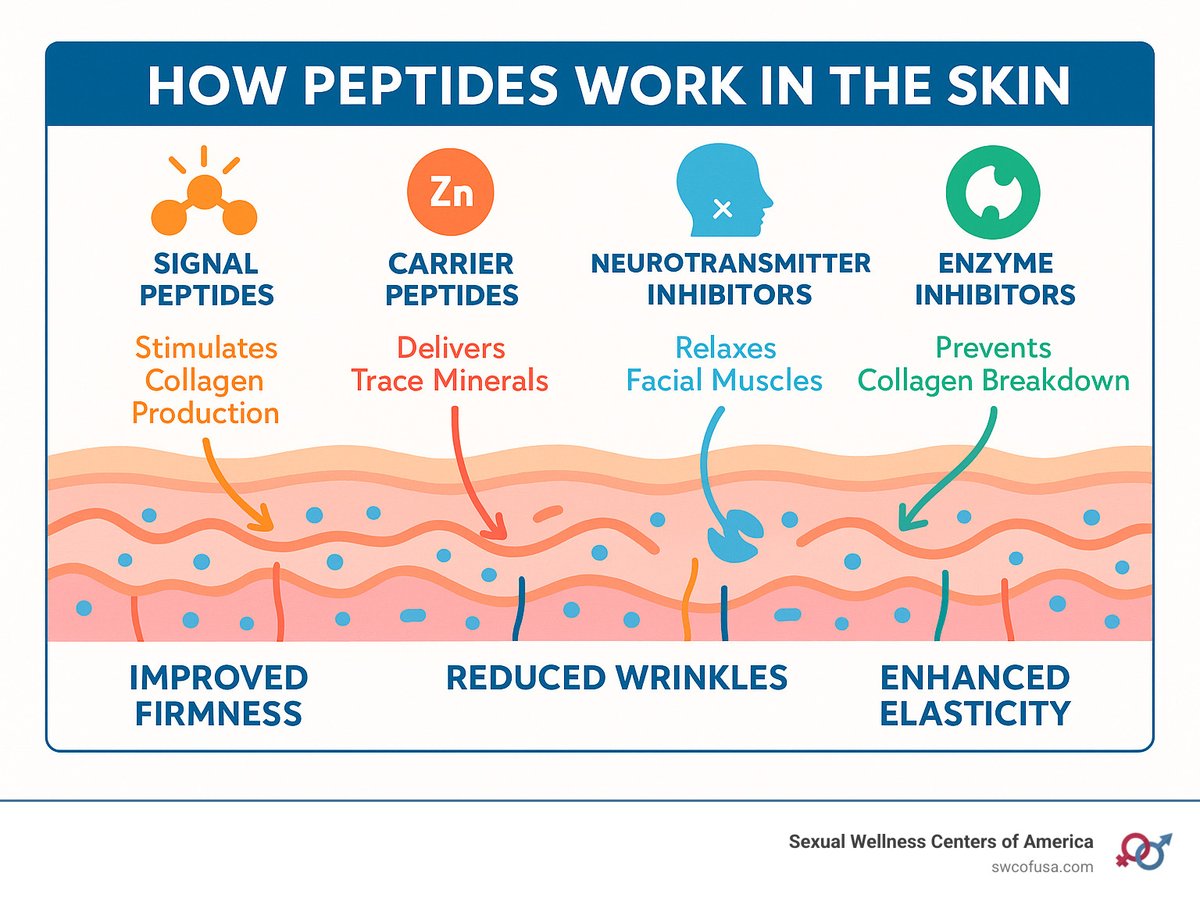
Not all peptides work the same way. The three main categories are signal peptides, carrier peptides, and neurotransmitter-inhibiting peptides. Signal peptides like the Matrixyl family (palmitoyl pentapeptide-4 and palmitoyl tripeptide-1) directly stimulate fibroblasts to produce collagen and elastin. Copper peptides act as carrier peptides that deliver copper ions into cells, which supports wound healing and enzyme function. Argireline is a neurotransmitter-inhibiting peptide that works similarly to botulinum toxin by reducing muscle contractions, which softens expression lines over time.
What the Clinical Research Actually Shows
The peptide skincare market is worth over three billion dollars, but the clinical evidence supporting individual peptide ingredients varies significantly. Some peptides have robust randomized controlled trials behind them, while others rely on in vitro data that does not always translate to real-world results on human skin.
Matrixyl (palmitoyl pentapeptide-4) has the strongest clinical track record. A 12-week, double-blind, placebo-controlled study published in the International Journal of Cosmetic Science found that a cream containing 3 ppm of palmitoyl pentapeptide-4 reduced wrinkle volume by 29 percent and skin roughness by 27 percent compared to baseline. Participants using the peptide cream showed statistically significant improvement over the placebo group in all measured parameters. A follow-up study at 24 weeks showed continued improvement, suggesting that peptide benefits accumulate over time.
Copper peptides have mixed evidence. They show clear benefits in wound healing studies — a 2018 review in Advances in Wound Care confirmed that copper peptides accelerate wound closure and promote angiogenesis. However, controlled trials for anti-aging outcomes are fewer and less conclusive. Some studies show improvement in skin density and fine lines, while others show no significant difference from placebo. Argireline has shown modest effects on expression lines in a handful of small studies, with results comparable to low-concentration topical retinoids but with fewer side effects.
The distinction between laboratory evidence and clinical outcomes matters enormously in peptide research. A peptide might show dramatic collagen stimulation in a petri dish but fail to penetrate the stratum corneum in sufficient concentration to produce the same effect on human skin. Penetration enhancement through proper formulation is the hidden variable that separates effective peptide products from marketing claims.
How to Choose an Effective Peptide Product
Peptide efficacy depends heavily on formulation, concentration, and delivery system. The peptide itself must be present at a clinically tested concentration, formulated with penetration enhancers, and packaged in a way that preserves peptide stability. Peptides are fragile molecules that degrade when exposed to air, light, and certain preservatives.
Look for products that list the specific peptide name and concentration on the label. Vague terms like peptide complex or peptide blend without naming the specific peptides are a red flag. Effective products typically contain one of the well-studied peptides at concentrations of 1 to 5 percent. Products with more than five different peptides are often using low concentrations of each, which dilutes efficacy.
Peptide serums should be packaged in airless pumps or opaque tubes. Dropper bottles expose the formula to air each time they are opened, which accelerates peptide degradation. The pH of the formula also matters — peptides are most stable in formulations with a pH between 5 and 7. Avoid peptide products with a low pH (under 4) unless they are specifically formulated to maintain peptide stability at that pH.
Combining Peptides With Other Anti-Aging Ingredients
Peptides work synergistically with several other anti-aging ingredients. Retinol and peptides are a particularly effective combination because they target collagen production through different mechanisms. Retinol increases fibroblast activity by binding to retinoic acid receptors, while peptides signal through growth factor pathways. Using both provides more comprehensive collagen stimulation than either alone.
Vitamin C and peptides can be used together, but with a caveat. L-ascorbic acid requires a low pH (under 3.5) to remain stable and penetrate effectively, while many peptides function best at a higher pH. Using a vitamin C serum in the morning and a peptide serum in the evening avoids this pH conflict. Some formulations now use stabilized vitamin C derivatives that work at a higher pH, making them compatible with peptides in a single product.
Hyaluronic acid is an excellent companion to peptides because hydrated skin absorbs peptides more effectively. Apply a hyaluronic acid serum to damp skin before your peptide treatment. Niacinamide also pairs well with peptides and adds additional barrier support and pore-refining benefits. Avoid combining peptides with strong AHAs or BHAs in the same application step, as low pH can destabilize peptide bonds.
Realistic Expectations: What Peptides Can and Cannot Do
Peptides offer genuine but modest anti-aging benefits. The best clinical data shows wrinkle reduction in the 20 to 30 percent range after three to six months of consistent use. This is less dramatic than prescription retinoids but comparable to many over-the-counter anti-aging ingredients. Peptides excel at improving skin firmness, density, and texture over time.
What peptides cannot do is replace lost collagen that has already broken down. They stimulate new collagen production, but they cannot rebuild sunken areas or restore the full collagen density of youthful skin. Deep wrinkles, severe sagging, and significant volume loss require in-office procedures like microneedling, laser resurfacing, or dermal fillers to address. Peptides are best viewed as a maintenance and prevention tool rather than a corrective treatment.
The cost of peptide serums ranges from $15 to over $200, but price does not correlate reliably with efficacy. Many affordable drugstore brands use clinically tested peptides at effective concentrations. Higher-end brands often layer multiple peptides in a single formula, which may offer additional benefits but is not strictly necessary for visible results. The most important factor is consistent daily use over several months, regardless of the price point.
Frequently Asked Questions
Common questions about the science of peptides
Can peptides replace retinol in an anti-aging routine?
Peptides and retinol work through different mechanisms and are best used together rather than as replacements. Retinol directly increases cell turnover and collagen production through nuclear receptors, while peptides signal collagen synthesis through growth factor pathways. Using both provides more comprehensive anti-aging coverage. If your skin cannot tolerate retinol at all, peptides combined with vitamin C and consistent SPF use offer a gentler but still effective alternative.
How long does it take to see results from peptide skincare?
Clinical studies show measurable improvements in wrinkle depth and skin firmness after 8 to 12 weeks of twice-daily application. Unlike retinoids, peptides do not cause a purge phase, so any results you see are purely positive. Continued use beyond 12 weeks produces additional cumulative benefits, particularly for skin density and overall texture.
Can I use too many peptides in my routine?
Using multiple peptide products in the same routine is unlikely to cause harm, but it may be wasteful. The maximum number of peptide receptors on skin cells is finite, and applying excessive amounts above what the receptors can bind does not produce additional benefit. One well-formulated peptide serum applied twice daily is sufficient to saturate the available receptors and achieve the full clinical effect.
Are peptides safe during pregnancy?
Most topical peptides are considered safe during pregnancy because they are naturally occurring amino acid chains that do not enter the bloodstream in significant amounts. Copper peptides, Matrixyl, and Argireline have no known pregnancy risks based on current evidence. However, always consult your obstetrician before introducing any new skincare ingredient during pregnancy, as individual circumstances vary.
Do peptides in skincare actually reach the deeper layers of skin?
Peptide penetration depends on molecular weight and formulation. Peptides with fewer than five amino acids (smaller than 500 daltons) penetrate the stratum corneum most effectively. Larger peptides require formulation strategies like liposomal encapsulation or penetration enhancers to reach the deeper epidermis. A well-formulated product from a reputable brand accounts for these factors, which is why product quality matters more than peptide concentration alone.
Related Articles
Your Next Step
Peptides are a scientifically validated addition to an anti-aging skincare routine, but they work best as part of a comprehensive strategy rather than a stand-alone treatment. Choose a product that lists specific peptides at known concentrations, use it consistently twice daily, and pair it with retinol and vitamin C for maximum collagen stimulation.
The clinical evidence supports peptides for modest but genuine improvements in wrinkle depth, skin firmness, and overall texture over three to six months of consistent use. Managing expectations is important — peptides will not transform your skin the way retinoids or professional treatments can, but they offer a well-tolerated option that works well alongside more potent ingredients.